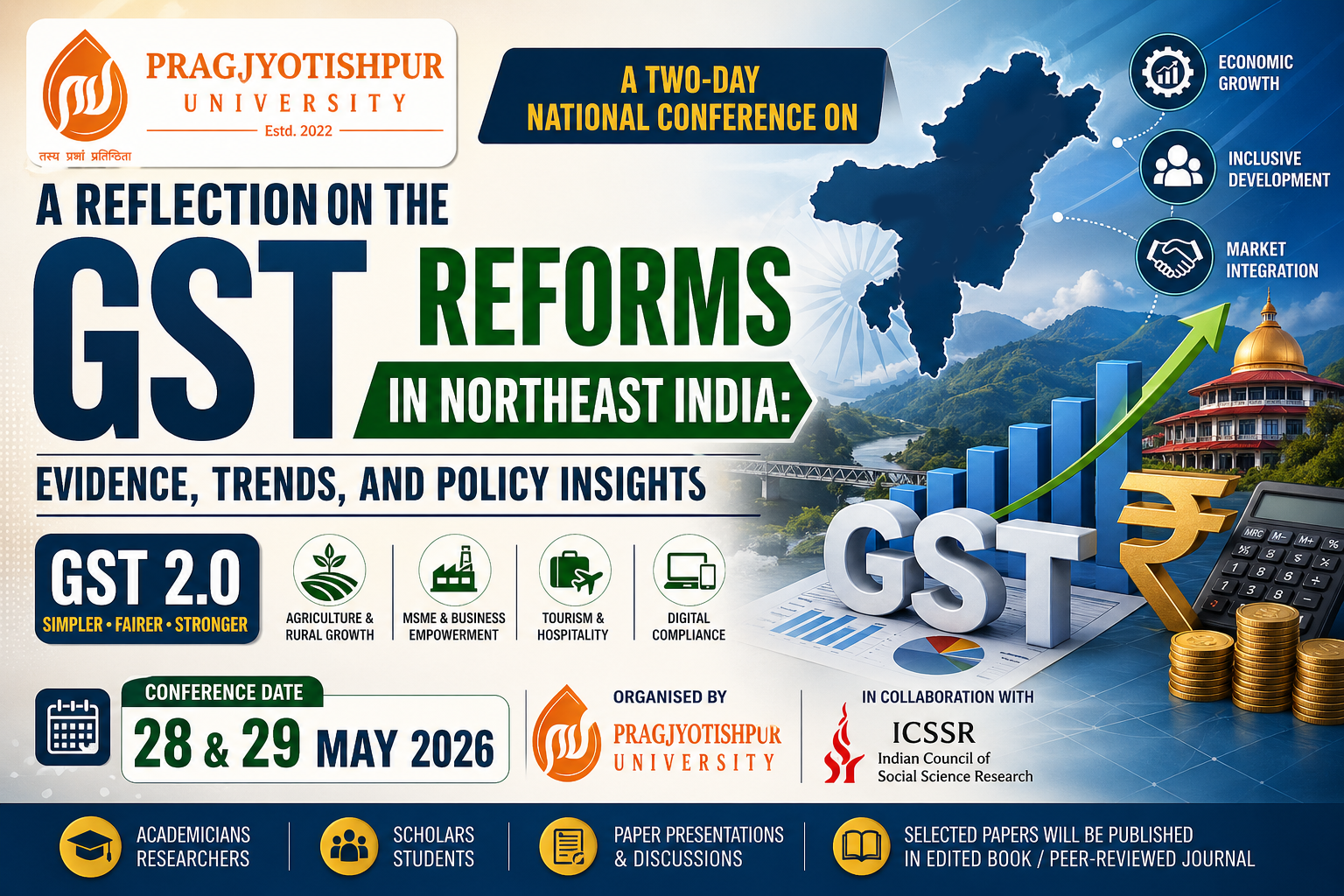
A Two-Day National Conference on
A Reflection on the Socioeconomic Impact of GST Reforms in Northeast India:
Evidence, Trends, and Policy Insights
Invitation
Pragjyotishpur University is organizing a two-day National Conference on the theme "Next-Gen GST Reforms (GST 2.0) and its Socioeconomic Impact on Northeast India", in collaboration with the Indian Council of Social Science Research (ICSSR). The seminar aims to provide an academic platform for meaningful deliberation on the evolving framework of GST, particularly the recent reforms focusing on rate rationalization, simplification, and inclusive growth.
Special emphasis will be laid on assessing the impact of GST on the North Eastern Region, especially in terms of fiscal empowerment, market integration, support to agriculture, handloom, handicrafts, tourism, and the challenges related to digital infrastructure and compliance. We cordially invite research papers from academicians, researchers, faculty members, and scholars. Original and unpublished papers reflecting theoretical, empirical, or policy-oriented insights are highly encouraged.
About the Seminar
The GST 2.0 Reforms have focused on simplifying the tax structure through rate rationalization and reduction of burden on essential goods, agriculture, and MSMEs. In Northeast India, a consumption-driven region, GST has strengthened fiscal capacity with notable growth in SGST revenues. Key sectors like agriculture, handloom, and tourism have benefited, improving livelihoods and competitiveness.
However, challenges such as weak digital infrastructure, compliance complexities, and high logistics costs persist. The seminar aims to examine these impacts, address regional challenges, and propose policy measures to promote socioeconomic equity and inclusive growth in the Northeastern states.
Sub-Themes
1. Impact of GST Reforms on MSME, Agricultural, and Tourism & Hospitality Sectors
- Impact on MSMEs: Challenges and opportunities for small businesses in adapting to GST compliance.
- Agricultural Sector Analysis: Effects of GST Reforms on farming, agro-processing, and rural livelihoods in Northeast India.
- Tourism and Hospitality: Socioeconomic shifts in industry due to GST reforms.
- Infrastructure Development: Linkages between GST revenues and investments in roads, connectivity, and urbanization.
- Inter-State Trade Dynamics: Facilitation of seamless commerce and reduction in border checkpoints.
2. Fiscal Transformation, Revenue Mobilization, and Economic Performance under GST Reforms
- Administrative competency, technology adoption and revenue collection: Revenue mobilization, trends in GST collection across Northeastern states post GST reforms.
3. Impact of GST Reforms on Employment, Poverty Reduction and Livelihood Changes
- Economic Growth Indicators: Influence of GST reforms on GDP, per capita income, and sectoral contributions in the region.
- Employment Generation: Job creation, skill development, and labor market changes under GST reforms.
- Reduction in economic inequality: GST's role in reducing inequality and enhancing social welfare programs post reforms.
- State-Specific Variations: Comparative evidence from Assam, Meghalaya, and other Northeastern states.
4. Governance, Compliance, Digitalization and Environmental Impact of GST Reforms
- Historical Context: Pre-GST Tax structures in Northeast India and rationale for their implementation.
- Environmental Implications: Indirect effects of GST reforms on sustainable practices and resource management in the region.
- Compliance and Digitalization: Adoption of technology in tax filing and administrative efficiencies.
- Challenges and Bottlenecks: Issues like connectivity, awareness, and enforcement in remote areas.
- Policy Recommendations: Future reforms for enhancing GST's positive impacts in Northeast India.
- Any other topic relevant to and within the purview of the main theme.
Paper Submission Guidelines
- Abstract should be set within 250 words and have 4–5 keywords.
- Length of the full paper should be within 3,000–5,000 words.
- All soft copies must be submitted in English, typed in MS Word, formatted in Times New Roman, size 12, 1.5-line spacing.
- Papers must carry proper references in conformity with APA style.
- Joint paper presenters have to register separately.
- Registration link: https://erp.pju.edu.in/seminar-registration
- Abstract and full-length papers must be submitted to: seminarpu2026@gmail.com
Important Dates
| Last date of abstract submission | 15 April 2026 |
| Intimation of acceptance of abstract | 18 April 2026 |
| Last date of submission of full paper | 6 May 2026 |
| Intimation of acceptance of full paper | 13 May 2026 |
| Early Bird Registration | 18 May 2026 |
| Conference Date | 28 & 29 May 2026 |
Registration Fees
| Category | Fee |
|---|---|
| Academicians / Faculty Members | ₹ 1,500/- |
| Research Scholars / Students | ₹ 800/- |
Bank Account Details
| Account Name | Pragjyotishpur University |
| Bank | Union Bank of India |
| Account No. | 380601010350772 |
| Branch | Chandmari Branch |
| IFSC | UBIN0538060 |
Organising Committee
| Chief Patron | Prof. Pradeep Kumar Joshi, Hon'ble Chancellor, Pragjyotishpur University |
| Patron | Prof. Smriti Kumar Sinha, Hon'ble Vice Chancellor, Pragjyotishpur University |
| Advisor | Prof. Jogesh Kakati, Registrar, Pragjyotishpur University |
| Convenor | Dr. Jinti Sharma, Assistant Professor (Commerce), Pragjyotishpur University |
Members
- Dr. Pranab Jyoti Kalita, Assistant Professor (Sanskrit)
- Dr. Momi Sarma, Assistant Professor (Assamese)
- Dr. Kalyanee Devi, Assistant Professor (AI/ML & Data Science)
- Dr. Susmita Roy Choudhury Deka, Assistant Professor (Psychology)
- Shri Nirupam K. Sinha, Assistant Professor (English)
- Smt. Iva Kalita, Assistant Professor (Sociology)
- Smt. Monami Deka, Assistant Professor (Economics)
- Dr. Chandra Moni Bhattarai, Assistant Professor (Political Science)
Register now
Supported by IQAC, Pragjyotishpur University
Contact: (+91) 98643 36517 | (+91) 87219 10187 | pju.edu.in